

re: presence
on a couple of pages out of my latest journal.

A few days ago, I wrote the final page in my journal1. Though I am big on analog writing (what a fancy word these days), I’m not a regular journaler. I often go days, sometimes weeks, even months without writing anything on there. Those are the times that I need it most, and when I return the first sentences always look something like this:
“It has been a moment and a half since I’ve scribbled words down. Suddenly, I became aware of how often I start my entries with this line.
‘It has been so long’… well hello, future old friend.
And how many more times do I exclaim having no patience to sit and write words? Often, likely.”
Then I ramble on about anything but the thing I’m thinking about. Things like:
“Growing. Growth comes in forms we rarely truly understand, I find. I am finding a lot about myself and the world around me these days. Not so much in the what, as much as the why.
Why this? Why not that?
This first awkward page of stumbling across thoughts, resisting the urge to drop the pen and stop writing, to let it trail down and turn into a doodle… only to lose the battle against the onslaught of all the other things calling for attention. Phone buzzes. Email pings. Music shifts into uncomfortable tunes. Hey Siri. Skip. “Sorry, there’s a problem with the app.”
The last time a deep thought sunk to the level where it took over fourteen pages of non-stop writing was now during the pre-pandemic era. It’s a sad thought to think, a strange sensation in the body to realize that it’s really been that long since it thought uninhibitedly, without a distraction clawing out of that flow. As if attention has dropped at the bottom of the predatorial food chain, an easy, unsuspecting prey.
“The question of choice makes me feel dizzy these days. Becoming more aware of the power and discretion of subconscious choosing is difficult to digest.”
It’s like trying to focus on a single point out the window on a moving train. Like someone spun you round a few turns, and then told you to count their fingers. They lift four. You drop on the floor instead.
When cognition is so overwhelmed by a constant blur of distractions, five minutes are simply not enough to recover that sense of space and time. One page is simply not enough to land and situate yourself in the present moment. Not even two. Sometimes it takes days of trying just a little bit more each time.
Sometimes it just doesn’t happen, and the sense of time passing without our consent can really fill us with so much grief. I see it as a loss of something we have so much love for: life, and living. It’s gotten so easy to give up the agency over this time to the modern-day predator. That’s not what this article is about, though. It’s about showing up to the page and meeting myself in the present moment.
“It’s been making me less and less willing to fight, more and more willing to surrender. More and more willing to let things be as they may, entrusting a process I could, in no way, shape or form, understand without forcing it to change.
It’s like particles—when observed, they shift. Transform. I’m a huge proponent of growth, always growing, shifting, changing. I am learning that sometimes growth can happen—and mostly does—when we aren’t looking.“
Journaling became a platform for my intellect to take over the reigns, to break down concepts in an attempt to categorize, simplify, codify, and sometimes just to put a full-stop on feeling whatever was going on in my body. To capture it on the page forced the feeling to either make sense or dissipate from my present reality. You’ve likely heard about this a lot these days—intellectualization2. It’s why these journal entries of mine can sound like someone running in circles around a topic they don’t want to address, anything but, in fact. Though sometimes, it’s not up to me.
Sometimes as I write, though my hand engages in what the mind is telling it to write as it tries to keep my person distracted from feeling an emotion, another part that’s subconscious leaves hint to a future self coming back with the capacity to understand the unsaid. Writer’s amnesia, I like to call it. The effect of reading a page of your own writing, sometimes from weeks, months, years ago, finally understanding that you knew much more than you let yourself realize.
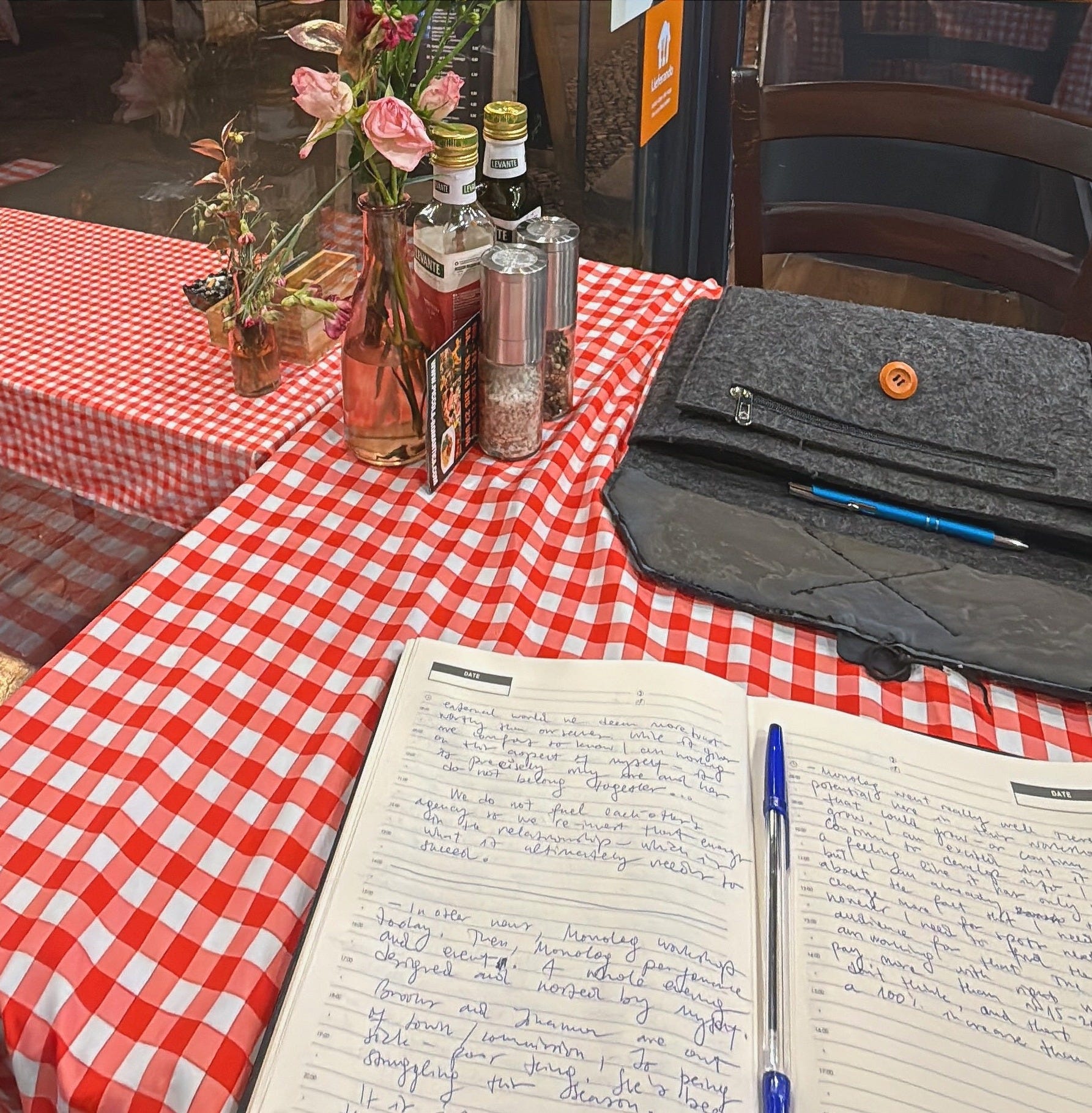
Sometimes, it’s less obvious than that.
“This to say, for so much of my life I’ve been trying to control the outcome, the path, direction… in which I was “intended” or “supposed” to grow into. But that felt like it came with a lot of assumptions as to what one is to become. And I’ve grown less fond of the idea of knowing what will come, over the years. These assumptions are not based on a reality I could possibly observe—they are quite literally daydreams.
Sometimes, very useful, other times maddening. My daydreams turned into somewhat of a nightmare, with encroaching anxieties gripping my perspective of the world and my place in it.”
I go on to describe how my anxieties were a product of deliberate judgement I was casting on my own person. Convincing myself I did something wrong, implied the right thing to do was out there, I had to go find it. Somehow, this small moment of prejudice gave me something I did not have in the present moment: control.
It felt like I had things under control. I understood, and so this must mean that the next step will be taken in a better direction towards a “better” path, a “better” becoming. Through this operative function of observing the self and breaking the concepts apart inside of me, I realize I had pushed her so far away from the experience of who I actually was.
“I’ve generalized her into systems… […] but I’ve come to want to get to know myself more than what a ‘self’ is. I feel I owe it to myself to know her more. Doing so in motion, with no deliberation but rather a quiet observation has been… healing? I feel I let myself fall in a warm embrace into myself more often. Not as often as I need to—but more often. I can even sleep much better, exactly because of this feeling. A sinking into my bones, a soothing of my muscles, a release of a deeply held breath of the day’s struggles and tension. It’s not enough to counteract all that I seem to carry all day, every day, but I am learning trust, I am learning to live in less despair.”
The act of letting go of futures imagined, for better or for worse, arriving in the present moment. Isn’t that the solution to most suffering? Aren’t there at least two ways of dealing with circumstance—one where you escape it, avoid the response-ability, and one where you accept it, understand where the feeling comes from within, and then either choose to stay in the discomfort so you grow through it, or leave so you spare yourself the suffering?
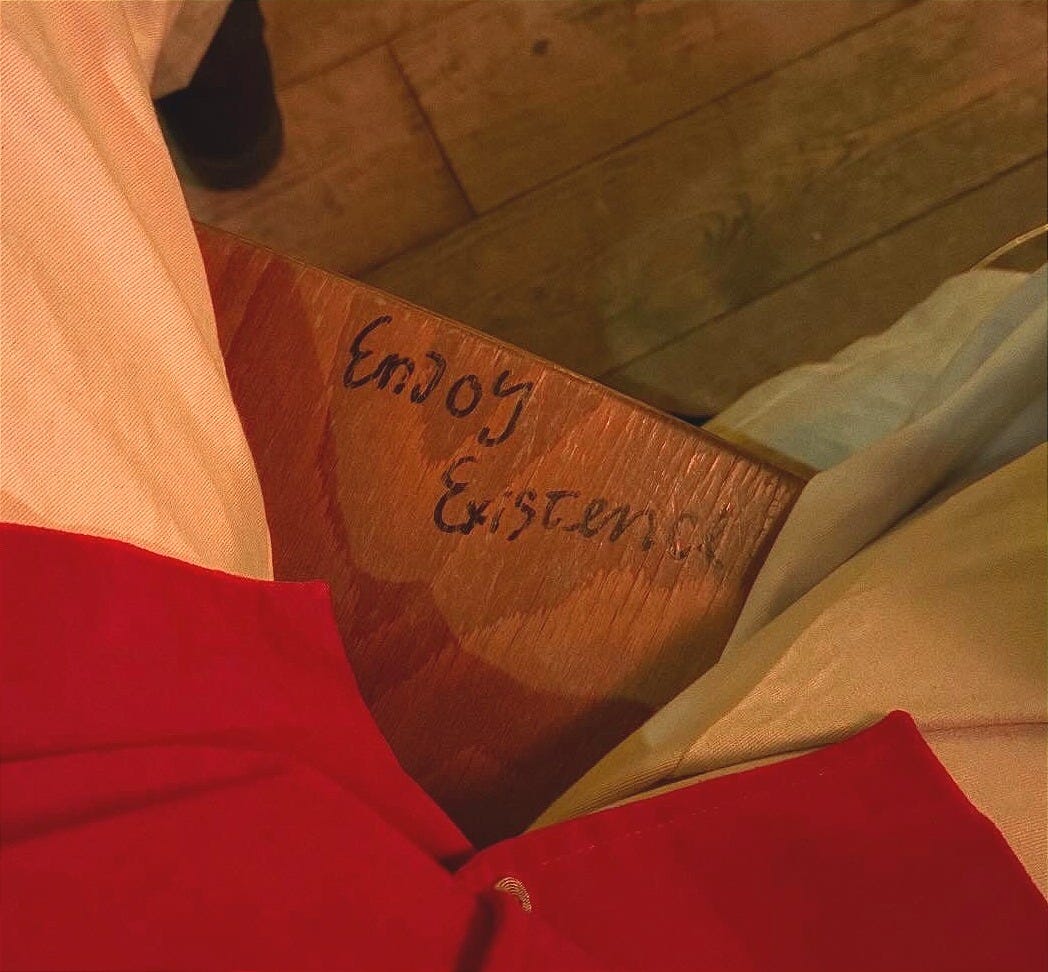
It felt as though I was being called onto a sort of change, and my reaction to it was to let myself ease into it. In no small part was that due to active therapy, part of which even included body-work which teaches a lot about the power of breath in releasing tension from the body. At this point of my life, therapy was my choice of sport.
I felt the more I learned about myself and the body I was living in, the more I understood my environment for what it was, not what I expected it to be. It expanded my capacity for empathy in understanding other people around me. In how we were the same, or different. In what I was choosing to see, and what I was projecting because I did not want to see, or witness, in myself. People are our greatest teachers in life. Another consistent teacher is life itself. Nature is ever evolving, ever changing, and I am of it, and from it. So how could we assume to be any different?
Which is why, this journal entry I flipped through caught me by surprise, written months later from the previous. I remember the day I wrote this page as if it was yesterday, in a deep state of despair. It had been a hard month. I grabbed my journal down from the table next to me, and wrote in one breath:
“I believe there is a part of me always waiting for the rest of me in my deepest depression. She sits in the middle of a softly-lit room, swinging gently in a chair, just waiting, patient. In a way, each time I meet her, she is almost smiling. Her face peaceful, surrendered. Her body almost motionless. Her eyes intentional, but soft, not invasive, as if she wants nothing more, not one thing of all the things the world has to offer—but to be there, as time passes, and the air around her shifts. Spiders make webs to capture their prey around her, she’s not even afraid. Her, and everything else that is, simply exist, together. Of all the things to hope for, she hopes for none. She breathes. Of all the things to wish for, all she is, is enough. Of all the things to be, she is—and that is enough. She is the quiet wolf, not one soft anything she wishes for but to sink into her own fur. I look at her, when I enter this room, surrendered, and I find a kind of quiet that soothes all my fears. I find a kind of quiet acceptance in being, as if just being in this room is enough. I see her. I know there is nothing to do at this moment than to be here.
To accept, and be accepted. I know, as I look into her looking into me, that we are free. I am free, and full, and so is she. I love her, and she loves all of me.
And now, I will make myself some warm soup.”
…
I ended up making red-lentil curry out of a recipe a friend of mine jotted down in my notes app. It was once again, delicious.
Dashni,
Bubamarrë 🐞
From June 2024 - January 2026. It starts with “Hello World. In this new decade of life, I find myself answering questions that convinced me adulthood is a real phenomenon.”
From Wikipedia: Intellectualization is a transition to reason, where the person avoids uncomfortable emotions by focusing on facts and logic. The situation is treated as an interesting problem that engages the person on a rational basis, whilst the emotional aspects are completely ignored as being irrelevant.